


All about Peppol and e-invoicing.
E-invoicing has been mandatory in Belgium since January 2026. This guide explains what you need to know about Peppol, the UBL format and how to comply.
What is the Peppol network?
Peppol (Pan-European Public Procurement OnLine) is a secure international network that lets businesses exchange electronic business documents. Designed for European public procurement, it has become the e-invoicing standard in many countries and will be mandatory across the European Union in 2030.
In practice, Peppol works like an “internet of invoices”. Just as an email travels from one address to another through different providers (Gmail, Outlook…), Peppol carries an invoice from one invoicing software to another, whatever system your customer uses.
Interoperability
Exchange with any business connected to the network, whatever software it uses.
Security
Exchanges are encrypted and authenticated, guaranteeing the integrity of documents.
Automation
Invoices are processed automatically: up to 80% fewer data-entry errors.
Speed
Invoices arrive instantly and get paid faster: your cash flow improves.
In Belgium, the government chose Peppol as the official network for B2B e-invoicing. Your company number (CBE) is built into your Peppol ID, which makes the switch much simpler.
Who does the obligation apply to?
Since 1 January 2026, structured e-invoicing has been mandatory for all transactions between VAT-registered businesses established in Belgium, including self-employed people and small businesses. The obligation stems from the transposition of the European directive and the Royal Decree of 14 July 2025.
✓ You are VAT-registered in Belgium
✓ You invoice other businesses (B2B)
✓ You receive invoices from Belgian suppliers
✓ You are self-employed, an SME or a large company
– B2C-only transactions (to private individuals)
– Businesses not subject to VAT
– Fully exempt businesses (article 44): doctors, dentists, physiotherapists, nurses, midwives, speech therapists, dietitians…
Important: the obligation covers both sending and receiving. Even if you invoice only occasionally or are exempt, you must be able to receive your suppliers’ invoices in structured electronic format. According to FPS Finance estimates, this concerns about 1.2 million Belgian businesses.
A PDF invoice is not an e-invoice.
Many businesses think they already comply because they send their invoices as PDFs by email. That is not the case: under the Royal Decree of 14 July 2025, only a structured invoice counts.
Visual, unstructured format
✕ An image of the document, like a photo
✕ Manual data entry required
✕ Risk of transcription errors
✕ Non-compliant since 2026
Structured, machine-readable format
✓ Structured, standardised data
✓ Automatic import into the accounts
✓ No data-entry errors possible
✓ Compliant with the 2026 legislation
The UBL format (Universal Business Language) is an international XML-based standard. It structures all the data of an invoice: number, date, amounts, VAT, customer and supplier details. Any compatible software reads and processes it automatically. It can also include a human-readable PDF version.
With Fidly, your customer receives a UBL file they import into their accounts in one click, along with the PDF version. No more data-entry errors, lost invoices or forgotten payments.
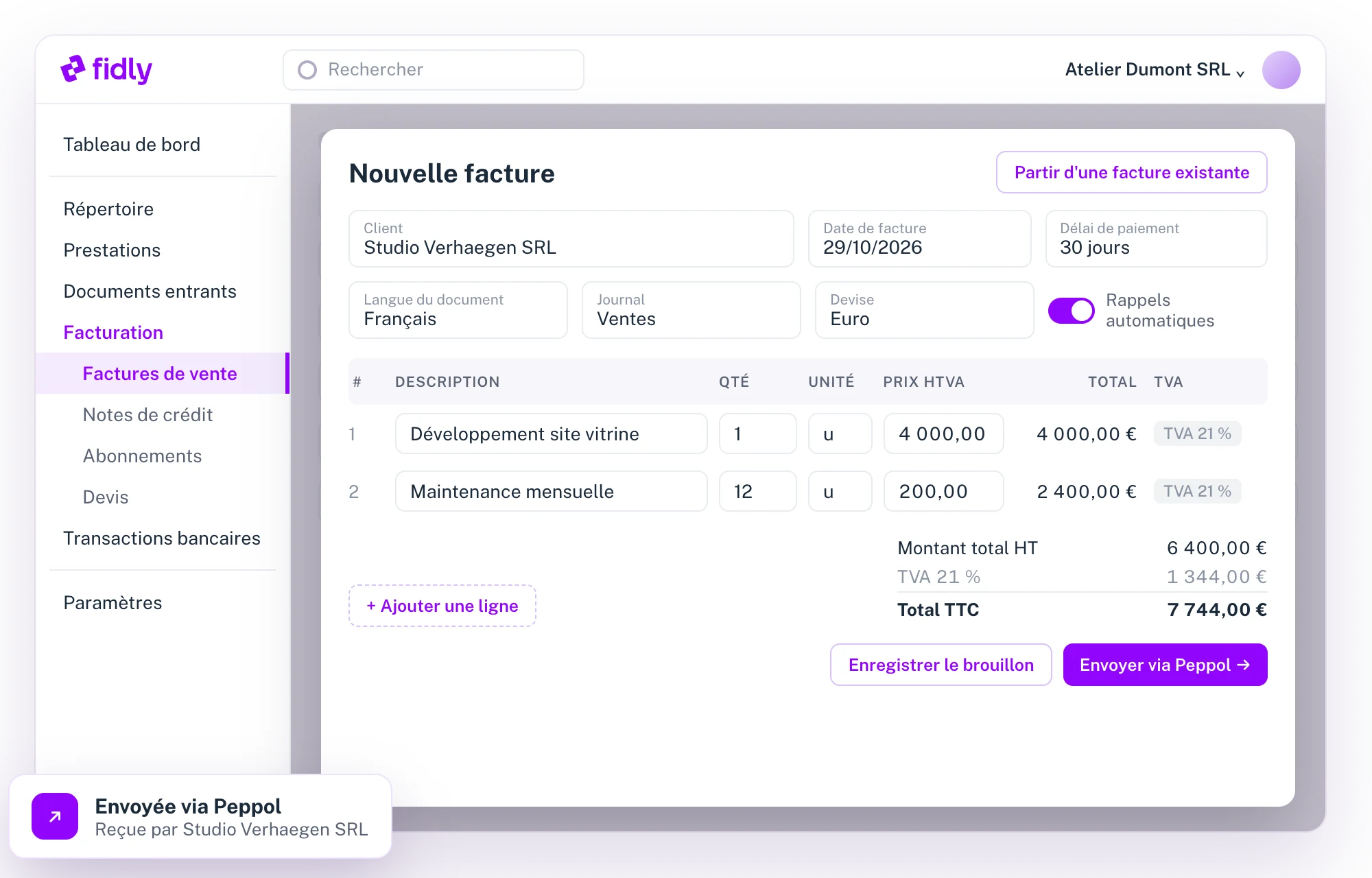
Sending an invoice via Peppol with Fidly.
Fidly uses a certified Peppol access point: you have nothing technical to set up, neither to send nor to receive.
Create your account
In under 2 minutes with your CBE number. Your Peppol ID is created automatically.
Create your invoice
As usual. Fidly generates the compliant UBL file and the PDF version.
Send via Peppol
One click on “Send” and the invoice reaches your customer. Private individual or foreign business? Send the PDF by email.
Track the payment
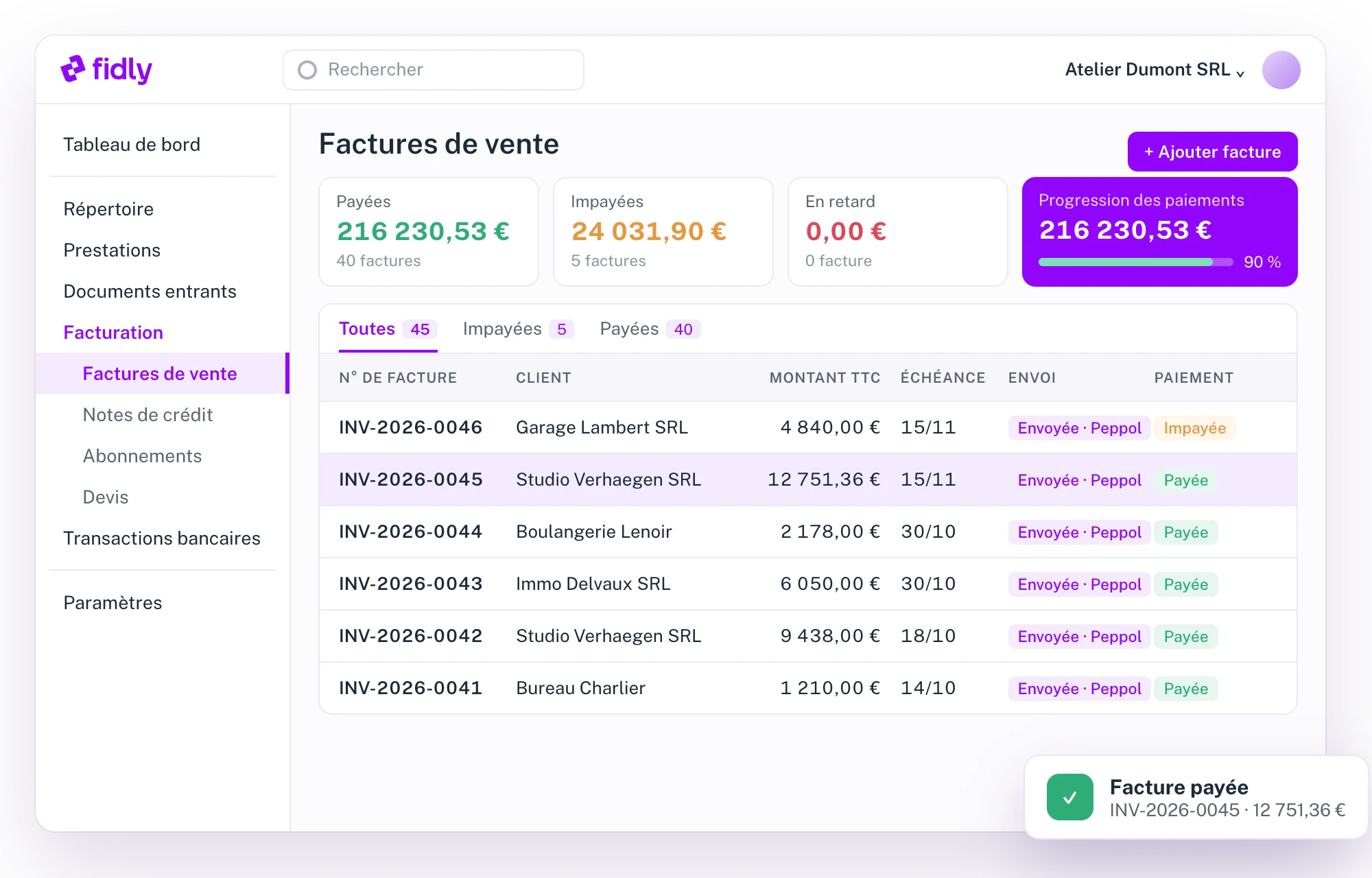
With your bank connected, Fidly detects the payment or sends an automatic reminder on time.
Frequently asked questions about Peppol.

A question about Fidly, its features or getting started? I'm here to advise and guide you.